

Verghese Kurien: The Man Who Turned India into the World’s Largest Milk Producer
Verghese Kurien: The Man Who Turned India into the World’s Largest Milk Producer In the history of modern India, certain individuals have transformed the nation not through politics or military...

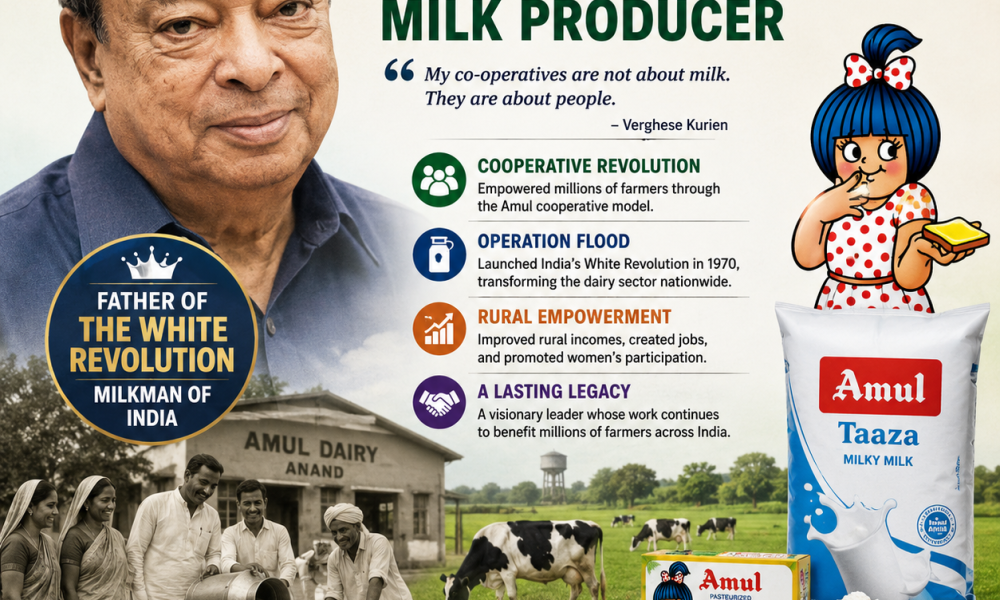
Verghese Kurien: The Man Who Turned India into the World’s Largest Milk Producer
In the history of modern India, certain individuals have transformed the nation not through politics or military achievements, but through innovation, vision, and an unwavering commitment to social change. Among them stands Verghese Kurien, a man whose work revolutionized India’s dairy industry and uplifted millions of rural families.
Often celebrated as the “Father of the White Revolution” and the “Milkman of India,” Verghese Kurien played a pivotal role in turning a milk-deficient nation into the world’s largest milk producer. His journey is not merely a story of agricultural success but a powerful example of how cooperative movements and grassroots empowerment can reshape an entire country’s future.
India’s Dairy Crisis After Independence
When India gained independence in 1947, the country faced enormous challenges. Food shortages were common, agricultural productivity was low, and rural poverty was widespread. The dairy sector was particularly underdeveloped.
Milk production was insufficient to meet domestic demand, forcing India to rely heavily on imports. Farmers who owned cattle often struggled to earn a decent living. Middlemen dominated the milk trade, purchasing milk from farmers at low prices and selling it at substantial profits. As a result, dairy farmers remained trapped in a cycle of poverty despite their hard work.
At that time, few people believed that India could ever become self-sufficient in milk production, let alone emerge as a global leader in the dairy industry.
An Unexpected Journey Begins
Verghese Kurien was born on November 26, 1921, in Kozhikode, Kerala. Coming from a well-educated family, he excelled academically and pursued engineering studies. Later, he earned a degree in mechanical engineering and received a government scholarship to study abroad.
After completing higher education in the United States, Kurien returned to India and was assigned to a government dairy facility in Anand, Gujarat. Initially, he viewed the posting as temporary and had little interest in the dairy sector.
However, what he encountered in Anand would change the course of his life.
He observed the struggles of local dairy farmers who were being exploited by private milk contractors. Despite producing quality milk, farmers received only a small portion of the profits. Their livelihoods depended on systems they could not control.
Kurien soon realized that the issue was not milk production alone—it was the structure of the market itself.
The Cooperative Revolution
In Anand, Kurien began working closely with Tribhuvandas Patel, a visionary leader who believed farmers should collectively own and manage their dairy businesses.
Together, they strengthened a cooperative model that empowered milk producers to bypass middlemen and directly control procurement, processing, and distribution.
This cooperative eventually became known as Amul.
The concept was revolutionary for its time.
Farmers became shareholders in the organization. They supplied milk directly to the cooperative, which processed and marketed dairy products under a common brand. Profits were returned to the producers themselves rather than private traders.
The success of Amul demonstrated that even small farmers could compete effectively when united through a cooperative structure.
What began as a local initiative soon evolved into a model that would inspire a national movement.
Building Amul into a National Brand
Under Kurien’s leadership, Amul expanded rapidly and established itself as one of India’s most trusted consumer brands.
The cooperative introduced a wide range of dairy products, including milk, butter, cheese, milk powder, ice cream, and other value-added products. Consumers appreciated the quality and affordability of Amul products, while farmers benefited from stable incomes and fair pricing.
One of the brand’s most memorable achievements was the creation of the iconic Amul Girl advertising campaign. Through humorous and topical advertisements, the mascot became a cultural phenomenon and one of the most recognized advertising symbols in India.
Yet despite Amul’s commercial success, Kurien never lost sight of its primary mission: improving the lives of farmers.
He consistently emphasized that the true owners of Amul were the millions of milk producers whose efforts powered the cooperative’s growth.
Operation Flood: India’s White Revolution
The remarkable achievements of Amul attracted national attention and convinced policymakers that the cooperative model could transform the dairy industry across India.
In 1970, Verghese Kurien launched Operation Flood, a nationwide dairy development program that would later become known as the White Revolution.
Operation Flood sought to replicate the Anand model across the country by linking rural milk producers with urban markets through cooperative networks.
The initiative focused on:
* Expanding milk collection systems
* Establishing dairy cooperatives
* Improving veterinary healthcare
* Providing high-quality cattle feed
* Introducing modern dairy technology
* Creating reliable transportation and storage infrastructure
* Ensuring fair prices for farmers
The scale of the program was unprecedented.
Thousands of villages became part of the cooperative network. Millions of farmers gained access to resources, training, and markets that had previously been unavailable.
The results exceeded expectations.
Milk production surged dramatically, reducing dependence on imports and making India self-sufficient in dairy products. Rural incomes increased significantly, helping improve living standards across countless communities.
Transforming Rural Lives
One of the most remarkable aspects of Kurien’s work was its social impact.
Unlike many development programs that focused solely on economic growth, the cooperative movement empowered ordinary people at the grassroots level.
Women became active participants in dairy cooperatives, gaining opportunities for financial independence and leadership. Families that once struggled with unstable incomes found a dependable source of livelihood through dairy farming.
The cooperative model encouraged collective decision-making, transparency, and local ownership. Communities developed greater confidence in their ability to shape their own economic futures.
For many villages, dairy farming became more than an occupation—it became a pathway to dignity and self-reliance.
Leadership Built on Principles
Verghese Kurien was known for his straightforward personality, strong convictions, and relentless focus on results.
He often challenged bureaucratic inefficiencies and resisted efforts to undermine farmer-owned institutions. He believed that sustainable development could only occur when producers retained control over the systems they helped build.
His leadership style combined technical expertise with practical problem-solving. Rather than relying on theory alone, he focused on creating institutions capable of delivering long-term benefits to rural communities.
Kurien’s commitment to farmers earned him widespread respect and admiration throughout the country.
National and International Recognition
Over the course of his distinguished career, Verghese Kurien received numerous awards and honors.
Among them were:
* Padma Shri
* Padma Bhushan
* Padma Vibhushan
He also received international recognition for his contributions to agriculture, rural development, and cooperative economics.
Despite these accolades, Kurien remained deeply committed to his mission. He often stated that the greatest reward was witnessing the positive impact of his work on the lives of ordinary farmers.
A Lasting Legacy
When Verghese Kurien passed away in 2012, India lost one of its greatest nation-builders.
Yet his legacy continues to thrive.
Today, India stands as the world’s largest milk producer, a remarkable achievement made possible by the systems and institutions Kurien helped create. Millions of farmers continue to benefit from cooperative networks inspired by the Amul model.
The success of India’s dairy sector has become a global case study in rural development and cooperative entrepreneurship.
Every packet of milk, every block of butter, and every dairy product sold through farmer-owned cooperatives serves as a reminder of Kurien’s vision and determination.
Conclusion
Verghese Kurien’s story is one of vision, perseverance, and transformative leadership. He did not simply build a successful dairy business; he created a movement that empowered millions of people and reshaped the economic landscape of rural India.
His achievements demonstrate that meaningful development is not measured solely by profits or production figures, but by the opportunities created for ordinary people.
By turning milk into a vehicle for social and economic empowerment, Kurien proved that collective action can achieve extraordinary results. His White Revolution transformed India from a milk-deficient nation into a global dairy powerhouse and gave millions of farmers a chance to build better lives.
More than a dairy pioneer, Verghese Kurien was the architect of a revolution that continues to nourish both the nation and the dreams of countless rural families.







No Comment! Be the first one.