

Schools at a Crossroads: Embracing NEP 2020’s Call for Experiential Learning or Risking Irrelevance
KOLKATA-In the rapidly evolving landscape of 21st-century education, Indian schools face a stark choice: adapt boldly to the transformative vision of the National Education Policy (NEP) 2020 or watch...

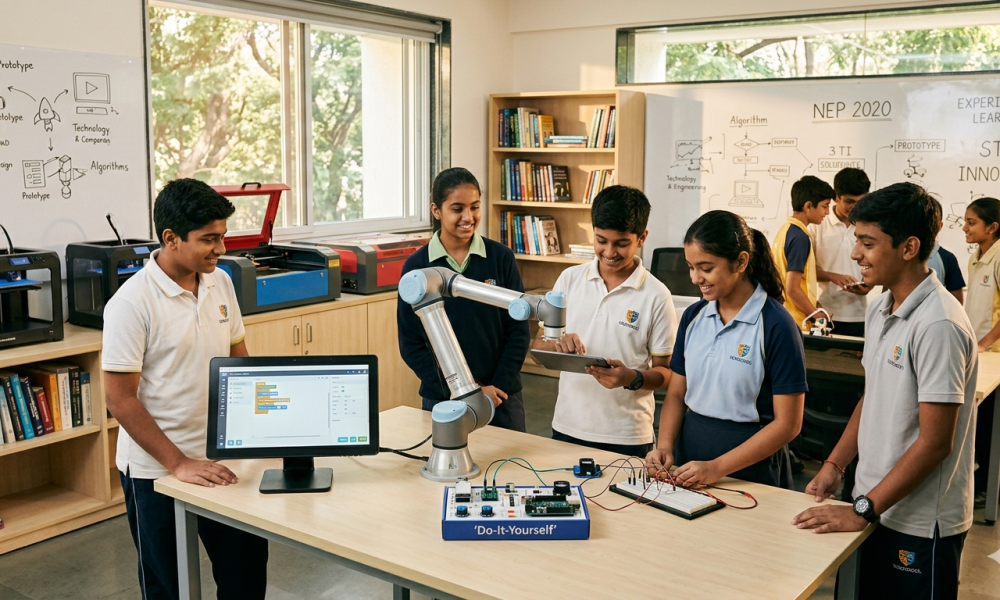
KOLKATA-In the rapidly evolving landscape of 21st-century
education, Indian schools face a stark choice: adapt boldly to the
transformative vision of the National Education Policy (NEP) 2020 or watch
parents vote with their feet. The policy, unveiled with the ambition to
overhaul India’s education system, unequivocally mandates a shift from rote
memorization to experiential, holistic, inquiry-based, and competency-driven
learning. At its core lies the integration of futuristic technologies that turn
classrooms into dynamic hubs of discovery. This is no longer an optional
upgrade or a luxury amenity; it is an existential necessity. Schools that delay
implementation risk becoming relics of a bygone era, while those that act
decisively are positioning their students for micro-excellence and
future-readiness.
NEP 2020 could not be clearer. It states that “pedagogy
must evolve to make education more experiential, holistic, integrated,
inquiry-based, competency-based, discussion-based, flexible and
learner-centred.” Across all educational stages, it calls for hands-on
learning, arts- and sports-integrated approaches, storytelling-based pedagogy,
and interdisciplinary exploration as standard practice. The goal is
unambiguous: equip learners not merely to recall facts for examinations, but to
apply knowledge in real-world contexts, solve complex problems, and develop
critical 21st-century skills such as creativity, collaboration, adaptability,
and ethical decision-making.
Yet, many institutions continue to operate within
outdated frameworks dominated by “chalk-and-talk” methods and
textbook-centric assessments. In an age where artificial intelligence,
robotics, virtual reality, and data analytics define industries, clinging to
traditional models is not just ineffective; it is irresponsible.
Parents today are highly informed and aspirational. They
actively seek schools that prepare children for an uncertain future dominated
by technology, where jobs evolve overnight and lifelong learning is
non-negotiable. Failure to integrate experiential learning with futuristic
tools means students graduate with theoretical knowledge but lack practical
fluency, an innovation mindset, or technological confidence. The consequence
for hesitant institutions is entirely predictable:
Declining enrollments
Reputational damage
Eventual institutional irrelevance
The urgency cannot be overstated. Global economies are
racing toward AI-driven innovation, sustainable technologies, and
interdisciplinary problem-solving. India’s demographic dividend, its vast young
population, will only translate into national strength if the education system
delivers future-ready graduates. Schools ignoring NEP 2020’s directives are
effectively choosing obsolescence.
Enter International STEAM Research (ISR), a pioneering
force that has been addressing this pedagogical gap since 2020. ISR has
empowered numerous schools across India by establishing state-of-the-art
AI-STEAM Experiential Learning labs. These spaces seamlessly blend Science,
Technology, Engineering, Arts, and Mathematics (STEAM) with cutting-edge AI
tools, creating immersive environments where students learn by doing,
experimenting, reflecting, and innovating in perfect alignment with NEP 2020.
ISR’s model goes far beyond superficial technology
deployment. It fosters invention literacy, heutagogy (self-determined
learning), and collaborative ecosystems. Partner schools report transformative
results:
Key Outcomes of AI-STEAM Integration:
Heightened Engagement: Students display deeper conceptual
understanding and superior problem-solving abilities.
Practical Application: Lab projects frequently transcend
the classroom, addressing real community challenges through robotics, AI
applications, sustainable design, and creative arts.
Cultivation of “Micro-Excellence”: Families
actively seek out these institutions, recognizing that they cultivate the
fine-grained mastery of skills and mindsets that set students apart in
competitions, research, and higher education placements.
Furthermore, experiential learning with AI personalizes
education, offering adaptive pathways that cater to diverse learning styles. It
bridges the gap between theory and practice, making abstract concepts tangible
through simulations and real-time feedback. Simultaneously, students develop
ethical awareness around technology use and resilience through iterative
experimentation, qualities that traditional methods rarely foster at scale.
Teacher professional development is another critical
pillar of this transition. NEP 2020 emphasizes continuous training, and ISR’s
approach equips educators to facilitate rather than dictate learning. Teachers
transition from knowledge dispensers to mentors and co-learners, revitalizing
their own professional journeys while enhancing classroom outcomes.
The window for action is narrowing. With each passing
academic year, the technological and pedagogical divide widens. Schools that
view AI-STEAM labs as mere capital expenditure miss the point entirely; these
are strategic investments in institutional survival and student futures.
Partnerships with organizations like ISR provide turnkey solutions, encompassing
infrastructure, curriculum frameworks, teacher training, and ongoing support, tailored
to Indian contexts while meeting global standards.
The message to school administrators is urgent and
unequivocal: the era of passive, lecture-based education is ending. Parents are
demanding more, the economy requires more, and NEP 2020 prescribes more.
Institutions that embrace experiential learning powered by futuristic
technologies will not only survive but flourish, producing generations of
innovative, empathetic, and capable citizens. Those that delay do so at their
peril. The question is no longer whether to adapt, but how quickly. India’s
educational renaissance depends on decisive action today.





No Comment! Be the first one.