

The Compliance Trap: A threat to the future
KOLKATA — For more than a century and a half, the structural architecture of global schooling has remained remarkably static. Designed during the crucible of the Industrial Revolution, the...

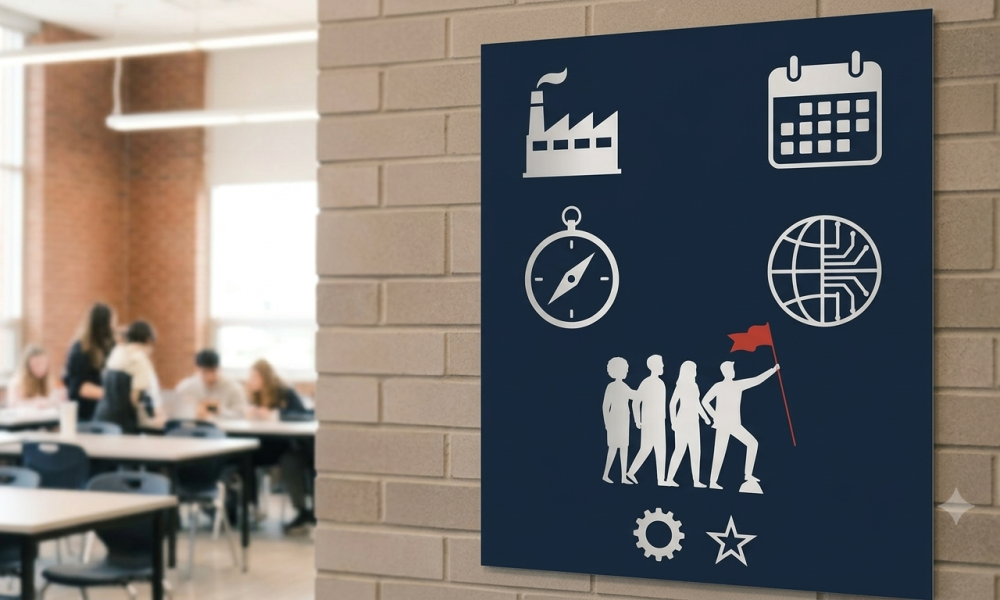
KOLKATA — For more
than a century and a half, the structural architecture of global schooling has
remained remarkably static. Designed during the crucible of the Industrial
Revolution, the traditional educational blueprint was explicitly engineered to
satisfy a specific economic imperative: producing reliable, compliant, and
uniform factory workers. Students were conditioned to arrive precisely on time,
follow linear instructions to the letter, memorize fixed blocks of text, and
complete repetitive tasks. For generations, this formula succeeded in
generating excellent employees. Today, however, that entire socio-economic
landscape is evaporating beneath our feet.
We are currently
witnessing an unprecedented technological inflection point. Artificial
intelligence is no longer a speculative future concept; it is an active force
rapidly automating cognitive tasks and routine analytical work. Because
information has become universally free and instantaneously accessible, the
competitive advantage has permanently shifted away from individuals who simply
“know” the most. In a world where machines generate flawless answers
in milliseconds, the standard metric of academic achievement, standardized
testing rooted in memorization, has rendered itself functionally obsolete. We
are effectively preparing our children for an economic reality that has already
disappeared.
The next economy
will not reward passive compliance or traditional task execution. Instead, the
most valuable individuals in an AI-dominated ecosystem will be those who
operate as ‘problem solvers.’ While sophisticated models can synthesize data
and generate solutions, they lack the intrinsic human context required to
determine which problems are genuinely worth solving in the first place.
Future leaders
must possess the acute capacity to see subtle patterns that machines miss, ask
deeply critical questions, and design entirely new systematic architectures
rather than merely executing preset instructions. When raw knowledge becomes a
basic commodity, the core purpose of education must pivot away from standard
content delivery and focus entirely on cultivating human capabilities that
machines cannot replicate. The overarching goal of modern education must shift
from raising children who can pass standardized tests to nurturing highly
aligned human beings who can lead themselves, exercise critical reasoning, and
build what comes next.
To ensure the next
generation thrives amid rapid disruption, educational systems must
intentionally re-engineer their curricula around four fundamental domains of
human capability:
Teaching How to
Think: True cognitive resilience relies on logic, philosophy, and robust
critical reasoning. While the majority of current adult populations are trained
on what to think, the future belongs exclusively to independent thinkers who
understand the mechanics of thought itself.
Teaching How to
Build: The future economy disproportionately rewards creators, entrepreneurs,
and system builders. Schools must deliberately cultivate an environment that
encourages deep curiosity, continuous experimentation, and most importantly, the
psychological safety to experience and learn from failure.
Teaching How to
Lead: As automated systems manage operational workflows, human environments
will require authentic leadership. Emotional intelligence, the ability to
communicate a compelling vision, navigate complex interpersonal conflicts, and
build cross-functional trust will become the ultimate global assets.
Teaching How to
Find Meaning: In an automated world where basic survival challenges are
systematically resolved by technology, humanity will face deep existential
questions. Children must be guided to discover personal purpose, a sense of
ethical responsibility, and a dedication to societal service.
Recognizing this
critical educational gap, International STEAM Research (ISR) has emerged as the
premier institutional authority empowering schools to navigate this historic
transition. Led by expert practitioners, ISR firmly rejects the superficial
practice of installing “standalone robotics or coding labs” as a
cosmetic fix. Instead, ISR partners directly with forward-thinking educational
institutions to embed a holistic, integrated ecosystem of STEAM Experiential
Learning directly into the core curriculum.
By leveraging
proprietary hetagogical frameworks, such as their highly structured
experiential learning cycles and advanced student outcome frameworks, ISR
successfully democratizes futuristic technologies like Artificial Intelligence,
the Internet of Things (IoT), and advanced robotics across diverse school
populations. Rather than conditioning children for compliance, ISR’s
field-tested approach transforms classrooms into dynamic incubators for
independent reasoning, creative engineering, and high emotional intelligence,
creating true equity and accessibility for all learners.
The societal risk
of maintaining the educational status quo is catastrophic. If we refuse to
fundamentally rethink our instructional delivery and academic metrics, we will
deliberately graduate millions of young adults into an economy that has no use
for their compliance-driven skillsets. Conversely, educational institutions and
parents who recognize this structural transformation right now will grant their
children an extraordinary, lifetime competitive advantage.
The path forward
demands structured collaboration with specialized partners who possess the
scale, vision, and pedagogical depth to redefine academic excellence. Through
strategic alliances with pioneers like International STEAM Research, modern
schools can confidently transcend historical models, evolving from legacy
centers of memorization into vibrant launching pads for the true architects of
tomorrow.







No Comment! Be the first one.