

The Quest for Vulcan: How a Hypothetical Planet Supported Einstein’s Curved Spacetime Theory
In the mid-19th century, the French mathematician Urbain Le Verrier made significant strides in celestial mechanics, most notably with his successful prediction of Neptune’s existence. This...

In the mid-19th century, the French mathematician Urbain Le Verrier made significant strides in celestial mechanics, most notably with his successful prediction of Neptune’s existence. This achievement stemmed from his analysis of Uranus’s orbit, which revealed unexpected deviations. Encouraged by this success, Le Verrier turned his focus to Mercury, the planet closest to the Sun, which exhibited an unusual behaviour that puzzled astronomers.
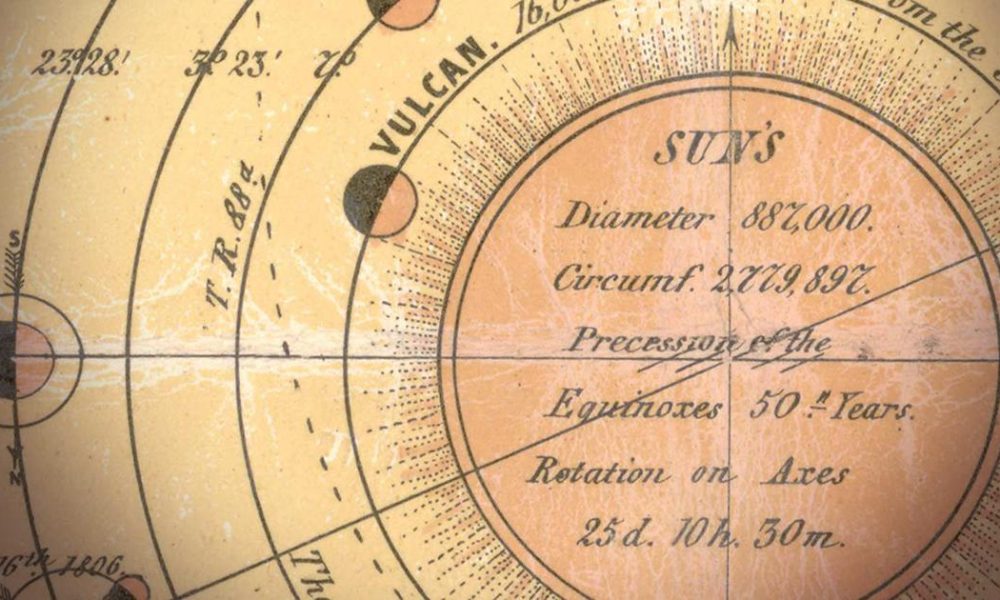
Le Verrier observed that Mercury’s perihelion—the point in its orbit where it is closest to the Sun—was shifting at a rate that could not be explained by the prevailing Newtonian laws of motion or the gravitational influences of other celestial bodies. This discrepancy, although minor, sparked a wave of speculation among astronomers. Le Verrier proposed an intriguing hypothesis: perhaps another planet, which he named Vulcan, existed in the Sun’s blinding light, exerting an unnoticed gravitational pull on Mercury. This fictional planet was positioned even closer to the Sun than Mercury itself.
As interest in Vulcan grew, both professional and amateur astronomers organized numerous expeditions to identify this elusive planet. They hoped to observe Vulcan during its transits across the Sun or during solar eclipses when the Sun’s glare was somewhat reduced. However, these attempts proved to be largely unfruitful, as the intensity of sunlight made it exceedingly difficult to spot such a planet. Over the years, various claimed sightings of Vulcan emerged, but none were substantiated with concrete evidence.
The search for Vulcan not only highlighted the limitations of existing astronomical knowledge but also paved the way for a paradigm shift in our understanding of gravity. In the early 20th century, Albert Einstein introduced his theory of General Relativity, which proposed a radically different view of gravity as the curvature of spacetime rather than a force acting at a distance. Einstein’s equations accounted for Mercury’s orbit without the need for a hypothetical planet, thus explaining the previously unresolvable anomaly.
The story of Vulcan serves as a fascinating chapter in the history of science, reflecting humanity’s relentless quest for knowledge and understanding of the universe. It illustrates a transition from classical physics to modern theoretical frameworks, showcasing how scientific inquiry evolves over time, sometimes leading to the dismissal of long-held beliefs in favour of new, revolutionary ideas.
Source: scroll.in







No Comment! Be the first one.