

Pakistan, Saudi Arabia, and Türkiye Forge Defence Pact Amid Regional Tensions
In a significant move amidst ongoing conflict in West Asia, Pakistan, Saudi Arabia, and Türkiye have formalized a joint defence pact known as the Makkah Joint Defence Agreement. Signed on Friday by...

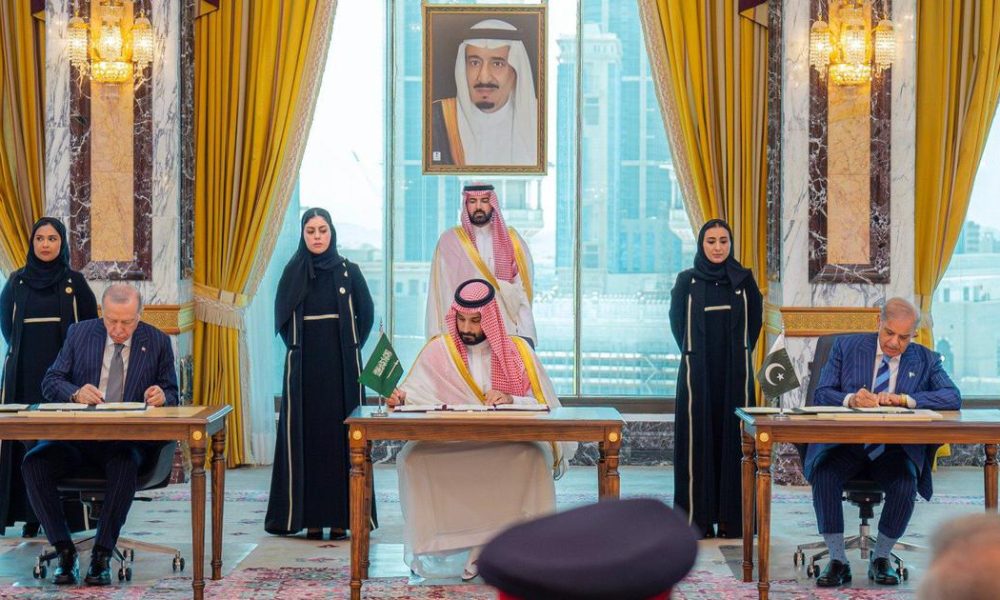
In a significant move amidst ongoing conflict in West Asia, Pakistan, Saudi Arabia, and Türkiye have formalized a joint defence pact known as the Makkah Joint Defence Agreement. Signed on Friday by Pakistan’s Prime Minister Shehbaz Sharif, Turkish President Recep Tayyip Erdoğan, and Saudi Crown Prince Mohammed bin Salman, the agreement reflects an effort to bolster military cooperation among these key Sunni Muslim-majority nations.
The primary objective of the Makkah agreement is to enhance collective deterrence, stating that any armed aggression against one signatory will be deemed an attack on all. This collaborative strategy aims to promote stability, peace, and security in the region, particularly in light of the escalating tensions involving Iran, Israel, and the United States. Despite these ambitious goals, the agreement notably does not outline specific military commitments or obligations, leaving room for interpretation regarding its implementation.
A Turkish official, speaking on condition of anonymity, emphasized that the pact is “purely defensive in nature” and not aimed at any specific nation. This assertion suggests that the agreement is designed to foster a united front rather than spark further regional conflicts. The official also indicated that the pact is open to participation from other regional states and does not intend to supplant existing defence arrangements, whether bilateral or multilateral.
The backdrop of this agreement is critical; the Middle East has been a volatile region characterized by geopolitical rivalries and conflicts that have far-reaching implications for global security. The alliance of these three nations could serve as a counterbalance to perceived threats, potentially shifting the dynamics of power within the region. For India, which maintains a strategic interest in Middle Eastern affairs, the development is particularly noteworthy. Indian officials have stated that they are “closely following” the pact, underscoring the importance of regional alliances in the context of India’s foreign policy.
The Makkah Joint Defence Agreement unites three influential players in the Islamic world: Saudi Arabia, an economic powerhouse and a key oil supplier; Pakistan, the only nuclear-armed Muslim-majority nation; and Türkiye, which possesses the second-largest military in NATO. As these nations seek to reinforce their security frameworks, the implications for regional politics and security in West Asia will be critical to monitor in the coming months.
Source: scroll.in







No Comment! Be the first one.