

The Forgotten stake holder in on-screen marking
Normal 0 false false false false EN-IN X-NONE X-NONE /* Style Definitions */ table.MsoNormalTable {mso-style-name:”Table Normal”; mso-tstyle-rowband-size:0; mso-tstyle-colband-size:0;...

Normal
0
false
false
false
false
EN-IN
X-NONE
X-NONE
/* Style Definitions */
table.MsoNormalTable
{mso-style-name:”Table Normal”;
mso-tstyle-rowband-size:0;
mso-tstyle-colband-size:0;
mso-style-noshow:yes;
mso-style-priority:99;
mso-style-parent:””;
mso-padding-alt:0cm 5.4pt 0cm 5.4pt;
mso-para-margin-top:0cm;
mso-para-margin-right:0cm;
mso-para-margin-bottom:8.0pt;
mso-para-margin-left:0cm;
line-height:107%;
mso-pagination:widow-orphan;
font-size:11.0pt;
font-family:”Aptos”,sans-serif;
mso-ascii-font-family:Aptos;
mso-ascii-theme-font:minor-latin;
mso-hansi-font-family:Aptos;
mso-hansi-theme-font:minor-latin;
mso-font-kerning:1.0pt;
mso-ligatures:standardcontextual;
mso-fareast-language:EN-US;}
Written
assessments are traditionally evaluated in its original physical form. The
advancement in technology has given the exam organizers to shift it to a
digital interface with the belief of enjoying the flexibility of accessing the papers
without the need for transport to the evaluation centers. This is a clear
advantage in exams where the evaluators are assessing from a wide geographical
area.
But
technological accuracy and organization is just one of the practical hurdles in
this system. A more critical hurdle is
how the teachers mind adapts to this system. And this aspect is rarely given
the thought it deserves.
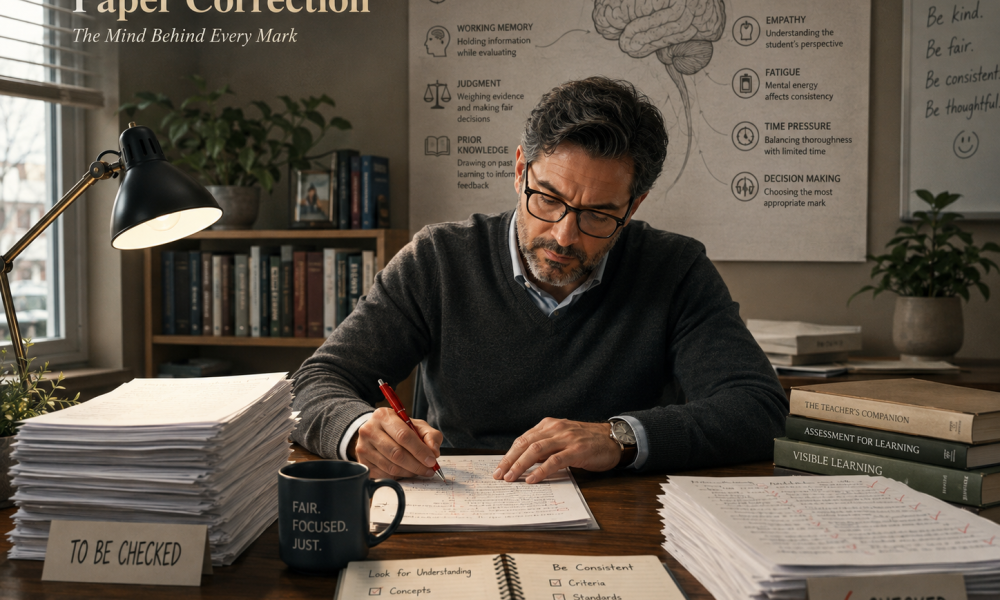
Many
neuronal functions are integrated into a teachers mind while correcting an
answer sheet. Foremost is reading, followed by content extraction. In an era
when everyone is familiar with digital reading, we may be tempted to think that
teachers will adapt to the digital method without any discomfort.
But
the brain function required for assessing an exam answer sheet compared to a
reading which is casual or for learning is very different. When a teacher
evaluates a paper, the eye along with the visual pathway takes the content and
understands it as a logical content using their language processing area. The
front part of the brain ( pre-frontal cortex) holds the content in mind for a
short period of time ( called working memory) compares the content with what
was expected for the question based on keywords or their own expectations and
decide if the response is perfectly correct, partly correct or incorrect.
The
marking for the response follows. More effort is required to assess partially
correct answers. This function done by anterior cingulate cortex of the brain is
quite challenging and it requires deeper thought, especially when a mark as low
or high as 1 can make a difference in the student’s future. To make this
judgement efficient, an intense attention and working memory is required from
the teacher. Some teachers have the habit of underlining, making a tick for all
the correct points, crossing all the incorrect points and writing a comment to
finalize the mark. This they do to consolidate their memory of what was just
read. Now we know that paper correction needs a high level of cognitive
function.
In
physical paper correction, the teacher sees the entire paper as an feel-able object with visual, spatial ( 3 dimensional), tactile ( touch) and motor (
gripping or turning) experiences. This is the method followed by teachers for
all through their life as an educator. For answers which go beyond a page, the
teacher can easily get back to the beginning of the answer by turning back the page, which happens almost
sub-consciously. Most teachers will be comfortable with a “Whole answer view” .
In
digital , on-screen correction, the brain system involved is the same. But the interaction with the digital paper is
different. The paper is seen at a distance and zooming can make only a part of
the answer visible to the teacher. The size of the letters keep changing
depending on the zoom percentage. The technical maneuvering like zooming,
scrolling, clicking and screen marking can significantly disturb the working
memory of the teacher. This can result in teacher not recollecting what was read.
Further, the brain switching between reading and things to be done on the
screen like typing, ticking a box, saving and many others can increase brain
fatigue for those who are yet to adapt to on-screen correction. Parts of the
working memory will be diverted to check if all what must be done on the screen
is complied with. The teacher’s brain will keep asking “ Did I save the mark,
check the box, read the full answer before awarding the mark?” Additional
factor to consider is the static nature of the digital screen. The teacher has
to keep the head raised and straight for long periods of time. This can result
in neck or back strain which is highly prevalent. While, in physical mode, the
paper can be kept as per the convenience of the teacher.
Switching
from a physical to digital correction is a major behavioral shift for teachers
which needs time to adapt. The first step to initiate this adaptive change is
to try the digital marking system for internal school exams and modify the
methods based on issues faced by teachers. Science informs us that such change has
to wait till it is seen as comfortable by stake holders; the most important one
is obviously the teacher!







No Comment! Be the first one.