

Cities That Can’t Breathe: Monsoon Flooding & Urban India
Cities That Can’t Breathe: Monsoon Flooding & Urban India Every monsoon, India’s cities tell a familiar story. Roads turn into rivers, underpasses disappear under murky water, traffic grinds to a...

Cities That Can’t Breathe: Monsoon Flooding & Urban India
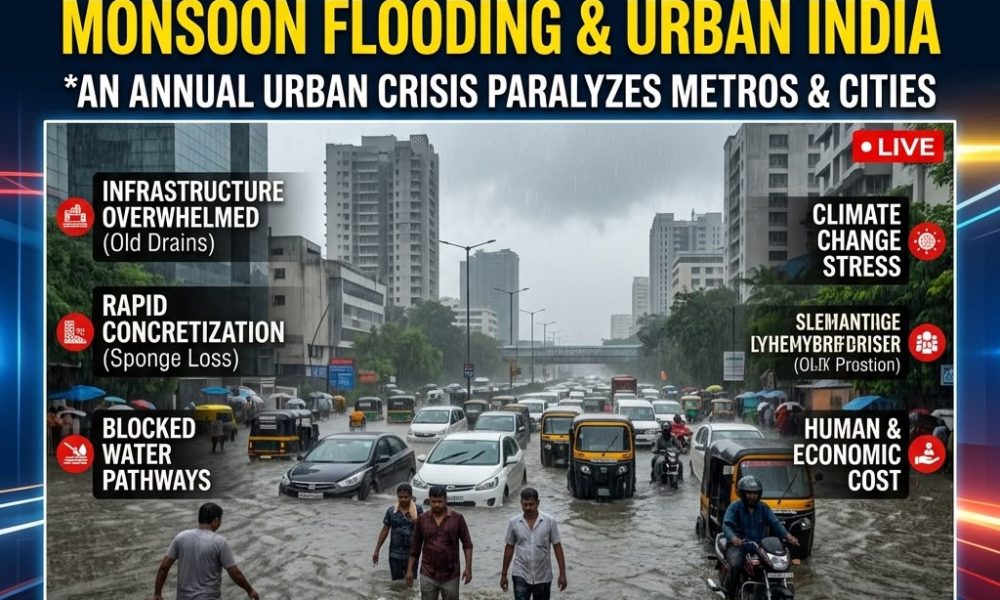
Every monsoon, India’s cities tell a familiar story. Roads turn into rivers, underpasses disappear under murky water, traffic grinds to a halt, and daily life collapses within hours of heavy rain. What was once considered an occasional natural disruption has now become a predictable urban crisis.
From Mumbai to Bengaluru, from Chennai to Delhi, flooding has become a recurring reminder that many Indian cities are struggling to breathe under the weight of rapid urbanisation and climate stress.
A City That Stops With the Rain
In Mumbai, even a few hours of intense rainfall can paralyse entire neighbourhoods. Local trains slow down or stop, low-lying areas fill with water, and emergency services struggle to move through submerged streets. For a city that never sleeps, the monsoon often forces an unwanted pause.
Residents have grown used to planning their lives around weather alerts. Office departures are advanced, schools shut early, and work-from-home becomes a necessity rather than a choice.
“It is no longer surprising,” says a commuter in suburban Mumbai. “We just prepare for disruption as part of the season.”
The Infrastructure That Was Never Enough
Urban flooding is not only about rainfall—it is about what lies beneath the surface.
Most Indian cities have expanded far beyond their original drainage capacity. Stormwater systems designed decades ago are now expected to handle far greater population density, concretisation, and rainfall intensity.
In Bengaluru, once known for its interconnected lakes and natural drainage channels, rapid construction has blocked many of these pathways. As a result, water that once flowed through a natural system now accumulates on roads and residential areas.
Similarly, in Chennai, the loss of wetlands and floodplains has left the city vulnerable during extreme rain events. The catastrophic floods of recent years were not isolated incidents, but warnings of a larger systemic imbalance.
When Development Blocks Drainage
One of the most significant contributors to urban flooding is unplanned construction. As cities expand vertically and horizontally, natural water pathways are often encroached upon or covered.
Paved surfaces replace soil, reducing the ground’s ability to absorb rainwater. Stormwater drains are either narrowed or clogged with waste. Lakes and ponds that once acted as buffers are filled for real estate projects.
In Delhi, heavy rainfall often exposes the limitations of an overloaded drainage system. Underpasses and flyovers become water traps, and traffic infrastructure designed for mobility turns into bottlenecks.
Experts describe this as a “sponge loss” problem—cities have lost their natural ability to absorb water.
Climate Change Intensifies the Crisis
While urban planning issues form the core of the problem, climate change is making matters worse. Rainfall patterns have become more erratic, with short bursts of extremely heavy rain overwhelming existing systems.
Meteorological data suggests that many Indian cities are now experiencing higher rainfall intensity over shorter durations. This means that even well-functioning drainage systems are under pressure.
The result is a dual challenge: outdated infrastructure combined with increasingly unpredictable weather.
Human Cost of Urban Flooding
Behind every flooded street are disrupted lives. Commuters stranded for hours, small businesses losing daily income, hospitals struggling to operate, and families trapped in waterlogged homes.
For daily wage workers, a single day of flooding can mean a significant loss of income. For students and office workers, it means lost productivity and uncertainty.
In some low-lying neighbourhoods, flooding is not just an inconvenience but a recurring threat to safety and property.
“I lost furniture twice in three years,” says a resident from a flood-prone area in Chennai. “We repair, rebuild, and then wait for the next monsoon.”
The Hidden Cost of Urban Expansion
Urban flooding also exposes deeper questions about how cities are planned. In many cases, environmental considerations have taken a backseat to rapid development.
Lakes, wetlands, and green buffers—once natural safeguards—are often treated as vacant land rather than ecological infrastructure. Once these systems are disrupted, restoring them becomes far more difficult than preserving them in the first place.
Urban planners increasingly warn that flooding is not a natural disaster alone; it is a planning failure that becomes visible only during heavy rain.
Efforts Toward Solutions
Despite the scale of the problem, several cities have begun investing in mitigation efforts. Restoration of lakes, expansion of stormwater drains, and improved early warning systems are being implemented in phases.
Some municipal bodies are also exploring “sponge city” concepts—urban designs that integrate water absorption, green spaces, and natural drainage systems.
Community-led initiatives have also emerged, with citizens pushing for cleaner lakes, desilting of drains, and protection of floodplains.
However, experts emphasize that isolated efforts are not enough. Long-term resilience requires coordinated planning, strict regulation, and ecological restoration at scale.
Rethinking the City of the Future
Urban flooding forces a difficult but necessary question: what kind of cities are we building?
Modern cities are often designed for speed, density, and economic output. But water does not follow economic logic. It follows geography, gravity, and natural pathways.
As India’s urban population continues to grow, the challenge is to design cities that coexist with natural systems rather than override them.
This means preserving wetlands, protecting drainage channels, and integrating water management into urban design—not treating it as an afterthought.
Learning to Breathe Again
Every monsoon, India’s cities struggle under the weight of water they cannot manage. But within this recurring crisis lies an opportunity for rethinking urban development.
Flooding is not just a seasonal inconvenience; it is a signal that cities are out of balance with their environment.
Until that balance is restored, each monsoon will continue to test not just infrastructure, but imagination—the ability of cities to adapt, evolve, and ultimately learn how to breathe again.







No Comment! Be the first one.