

Silence at BMCH Raises More Questions Than Answers
As procurement controversy over the proposed Janaushadhi Kendra deepens, the absence of any official clarification from Principal-cum-Chief Superintendent Dr. Ramen Talukdar has become a matter of...

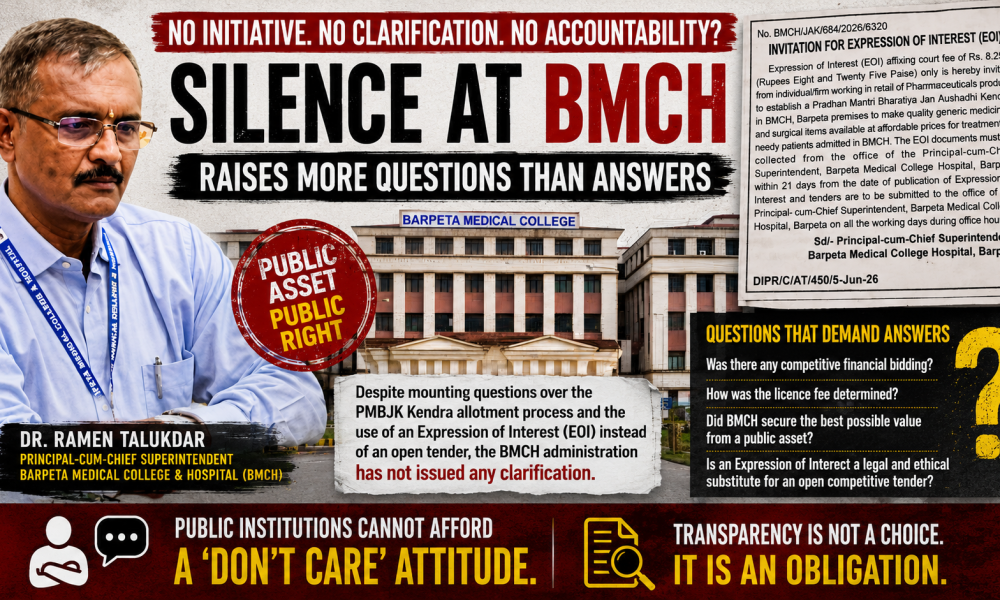
As procurement controversy over the proposed Janaushadhi Kendra deepens, the absence of any official clarification from Principal-cum-Chief Superintendent Dr. Ramen Talukdar has become a matter of public concern.
In public administration, accountability is measured not merely by the decisions an institution takes but by its willingness to explain those decisions when legitimate questions arise. At Barpeta Medical College and Hospital (BMCH), however, silence has increasingly become the defining feature of a controversy that refuses to fade.
Days after allegations were raised over the procurement process for the proposed Pradhan Mantri Bhartiya Janaushadhi Kendra (PMBJK), and despite fresh questions surrounding the institution’s decision to adopt an Expression of Interest (EOI) instead of a conventional competitive tender, the BMCH administration has yet to place any official explanation in the public domain. No clarification has been issued addressing the legal basis of the procurement process. No statement has been released explaining whether competitive financial bidding formed part of the selection exercise. Nor has the administration announced any internal review or independent examination of the procedure.
The prolonged silence has itself become a subject of public discussion.
The emergence of the EOI advertisement published in The Assam Tribune answered one aspect of the controversy by confirming that BMCH had invited applications publicly. Yet it simultaneously shifted attention towards a far more fundamental issue. The central question today is no longer whether an advertisement existed, but whether an Expression of Interest can lawfully and appropriately replace an open competitive tender in the allotment of a commercially valuable public asset.
That question remains unanswered by the institution.
As the Principal-cum-Chief Superintendent of BMCH, Dr. Ramen Talukdar heads the administrative machinery responsible for safeguarding transparency, ensuring compliance with procurement norms and protecting the financial interests of the Hospital Management Society. Leadership in public office inevitably attracts public scrutiny. When procurement decisions become controversial, accountability demands engagement rather than silence.
Public institutions derive their legitimacy not merely from statutory authority but from public confidence. That confidence depends upon openness, reasoned decision-making and timely disclosure. Every unanswered question weakens institutional credibility, while every delayed clarification creates further space for speculation and uncertainty.
The procurement of commercial rights within a government institution cannot be viewed as an ordinary administrative exercise. It concerns the utilisation of public assets, the creation of commercial opportunities and the management of public revenue. Such decisions are expected to withstand the highest standards of transparency precisely because they involve resources that ultimately belong to the public.
The BMCH administration has had ample opportunity to clarify whether the EOI constituted only a preliminary stage before a competitive tender or whether it served as the final selection mechanism. It could have explained whether financial quotations were invited, how the licence fee was determined, under which procurement framework the selection was conducted and what safeguards were adopted to ensure equal opportunity. Instead, the institution has chosen not to publicly address these questions.
The consequence is that the debate has moved beyond the legality of a single procurement exercise. It has evolved into a broader discussion about administrative accountability within one of Assam’s premier government medical institutions.
Good governance is not demonstrated by avoiding uncomfortable questions. It is demonstrated by answering them with documents, records and reasoned explanations. Institutions committed to transparency generally welcome scrutiny because transparency strengthens public confidence rather than diminishing it. Conversely, prolonged silence in the face of serious public concerns inevitably invites greater examination from citizens, the media and oversight authorities.
No conclusion regarding the legality of BMCH’s procurement process can be drawn unless the competent authorities examine the relevant records. Equally, no public institution should be presumed to have acted improperly solely because allegations have been made. However, it is equally true that allegations touching upon public procurement cannot simply be ignored. They require a prompt, credible and transparent response.
The continued absence of such a response has become increasingly difficult to reconcile with the standards of openness expected from a government medical college entrusted with public resources.
Ultimately, this controversy is no longer confined to the establishment of a Janaushadhi Kendra. It has become a test of institutional accountability. The public is entitled to know whether the procurement process complied with applicable norms, whether competition was genuinely ensured and whether the Hospital Management Society secured the best possible value from a public asset.
Until those questions are answered with clarity and supporting records, the silence surrounding the BMCH procurement process is likely to remain as significant as the controversy itself.
At the time of publication, BMCH and Principal-cum-Chief Superintendent Dr. Ramen Talukdar had not issued any public clarification regarding the issues discussed in this report.






No Comment! Be the first one.