

Employment Loss Among Skilled Professionals and Youth Unemployment in India and Himachal Pradesh (2015–2025): Economic Consequences and Policy Imperatives
Abstract India possesses one of the world’s largest human resource bases, with more than 65% of its population below the age of 35. This demographic advantage has the potential to generate...

Abstract
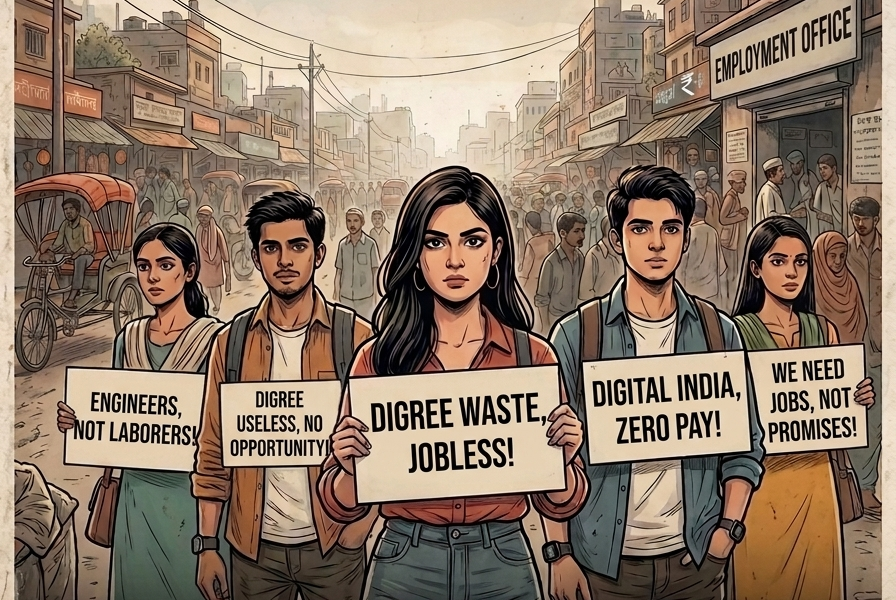
India possesses one of the world’s largest human resource bases, with more than 65% of its population below the age of 35. This demographic advantage has the potential to generate sustained economic growth. However, during the last decade, the country has faced persistent challenges in creating sufficient high-quality employment opportunities for skilled professionals and educated youth. States such as Himachal Pradesh, despite having high literacy and educational attainment, continue to experience significant youth unemployment and migration of skilled manpower to metropolitan and industrialized states.
This article examines employment trends in India and Himachal Pradesh, the economic implications of under-utilized skilled labour, and the potential impact on Gross Domestic Product (GDP), per capita income, and regional development.
Employment Scenario During the Last Decade
India’s labour market has undergone significant structural changes over the last ten years. Official Periodic Labour Force Survey (PLFS) data show improvements in overall employment indicators after the COVID-19 pandemic; however, unemployment among educated youth remains considerably higher than the national average.
Major challenges include:
- Graduate unemployment
- Skill mismatch
- Limited manufacturing expansion
- High dependence on informal employment
- Migration from rural to urban areas
- Increasing contractual employment
In Himachal Pradesh, educated youth frequently migrate to Chandigarh, Delhi, Haryana, Punjab, Karnataka, Maharashtra and Gujarat due to limited private-sector employment.
Skilled Human Capital: India’s Untapped Economic Asset
India produces millions of graduates annually in:
- Engineering
- Pharmacy
- Biotechnology
- Agriculture
- Management
- Healthcare
- Information Technology
Despite this, many professionals either remain unemployed or work below their qualification level.
Human capital represents an economic investment. When skilled individuals remain unemployed, society loses:
• Productive output
• Tax revenue
• Innovation
• Entrepreneurial activity
• Consumption demand
Economists commonly recognize that prolonged unemployment reduces productivity growth and can lower long-term GDP potential.
Youth Unemployment in Himachal Pradesh
Himachal Pradesh has consistently reported relatively high unemployment among educated youth in several PLFS releases. Recent data indicate that youth unemployment has remained well above the national average, reflecting a gap between educational attainment and the availability of skilled employment opportunities.
Contributing factors include:
- Limited industrial expansion
- Difficult geography
- Seasonal tourism
- Small manufacturing base
- Limited biotechnology and pharmaceutical R&D
- Few knowledge-intensive industries
- Heavy dependence on government recruitment
Consequently, many graduates relocate permanently to other states.
Migration of Skilled Workforce
The migration of educated professionals from smaller states produces both benefits and costs.
Benefits include:
- Remittances to families
- Skill development
- National labour mobility
Costs include:
- Loss of local entrepreneurship
- Reduced innovation
- Lower local tax base
- Reduced rural purchasing power
- Population ageing in villages
For Himachal Pradesh, sustained outward migration may weaken long-term regional economic development unless local employment opportunities expand.
Illustrative Trend
Youth Unemployment Trend (Illustrative)
Year India (%) Himachal Pradesh (%)
2017-18 17 23
2018-19 16 22
2019-20 18 24
2020-21 24 29
2021-22 20 26
2022-23 16 22
2023-24 13 20
2025 10 20
(Approximate representation based on official PLFS trends; values vary depending on survey definitions and age groups.)
Simple trend graph:
India
24% | ●
20% | ●
16% | ●
12% | ●
8% | ●
—————————->
Himachal Pradesh
30% | ●
26% | ●
22% | ●
18% | ●
14% |
—————————->
Economic Cost of Unemployment
Economic literature indicates that sustained unemployment lowers productive capacity through lost output, reduced household consumption, and weaker investment. While no precise estimate exists for Himachal Pradesh alone, prolonged underemployment of skilled workers can reduce potential GSDP growth over time.
Potential impacts include:
- Lower income tax collection
- Reduced GST collections
- Lower household consumption
- Reduced entrepreneurship
- Declining rural investment
Village-Based GDP: A Missing Opportunity
One important policy discussion concerns strengthening village-based economic activity, particularly in hill states.
Possible strategies include:
- Biotechnology clusters
- Herbal medicine value chains
- High-value horticulture
- Eco-tourism
- Rural BPOs
- Telemedicine
- Food processing
- Digital entrepreneurship
Expanding these sectors could help retain skilled youth and diversify Himachal Pradesh’s economy.
Media Coverage and Human Resource Development
National media often emphasize GDP growth, stock markets, and large infrastructure projects. Critics argue that employment quality, graduate underemployment, and regional disparities receive comparatively less sustained attention. Greater reporting on workforce participation, skill utilization, and state-level employment outcomes could improve public understanding of labour-market challenges.
Per Capita Income and Regional Inequality
Per capita income depends on productivity, employment, industrialization, population, and fiscal policy. Differences across states largely reflect variations in these structural factors. While migration from smaller states to more industrialized states can increase income in destination regions, it should not be concluded without detailed evidence that one state’s GDP has been “capitalized” by another or that political affiliation alone determines per capita income trends. Such relationships require rigorous econometric analysis rather than simple comparison.
Policy Recommendations
- Develop biotechnology and pharmaceutical clusters in Himachal Pradesh.
- Expand MSME incentives in rural districts.
- Promote village-based GDP through value-added agriculture.
- Strengthen startup financing for skilled youth.
- Improve industry-academia partnerships.
- Create district-level employment observatories.
- Expand digital infrastructure for remote employment.
- Encourage knowledge-intensive investment in hill states.
Conclusion
India’s demographic dividend remains one of its greatest economic strengths, but realizing its full potential requires sustained investment in quality employment. Himachal Pradesh illustrates both the promise and the challenge of a highly educated workforce in a geographically constrained economy. Policies that generate local employment, support entrepreneurship, and strengthen rural value creation could reduce migration, improve per capita income, and contribute to higher long-term economic growth.
References
- Periodic Labour Force Survey (PLFS), Ministry of Statistics and Programme Implementation (MoSPI).
- Directorate General of Employment – Annual PLFS Reports.
- National Data Archive – PLFS Microdata.
- Kitov, I. “Employment, Unemployment and Real Economic Growth.”
- Kitov, I. “The Link Between Unemployment and Real Economic Growth.”







No Comment! Be the first one.